Multilingual HREDD Digital Toolbox
Structured Multilingual HREDD Digital Infrastructure for Business Guidance, Institutional Governance, and Long-Term Platform Continuity
business-humanrights.be was delivered as a multilingual official digital toolbox and reference platform designed to help businesses engage with Business and Human Rights and Human Rights and Environmental Due Diligence (HREDD) in a more practical, structured, and usable way.
Developed in collaboration with the Council of Europe, Belgian FPS Justice, and academic partners including KU Leuven (HIVA), VUB (Brussels School of Governance), and NOVA School of Law, the platform was built to transform complex legal, policy, and academic content into a digital environment that businesses and stakeholders can actually use, not just read.
This was not a standard website assignment. It required the creation of a credible, institution-ready digital system capable of supporting multilingual access, practical self-guidance, and long-term content governance in a policy-sensitive domain.
Spontan Agency served as the lead digital partner for strategy, UX structuring, and technical development, delivering a maintainable platform with multilingual infrastructure, functional user tools, and a full continuity handover package (source code, technical manual, and team training).
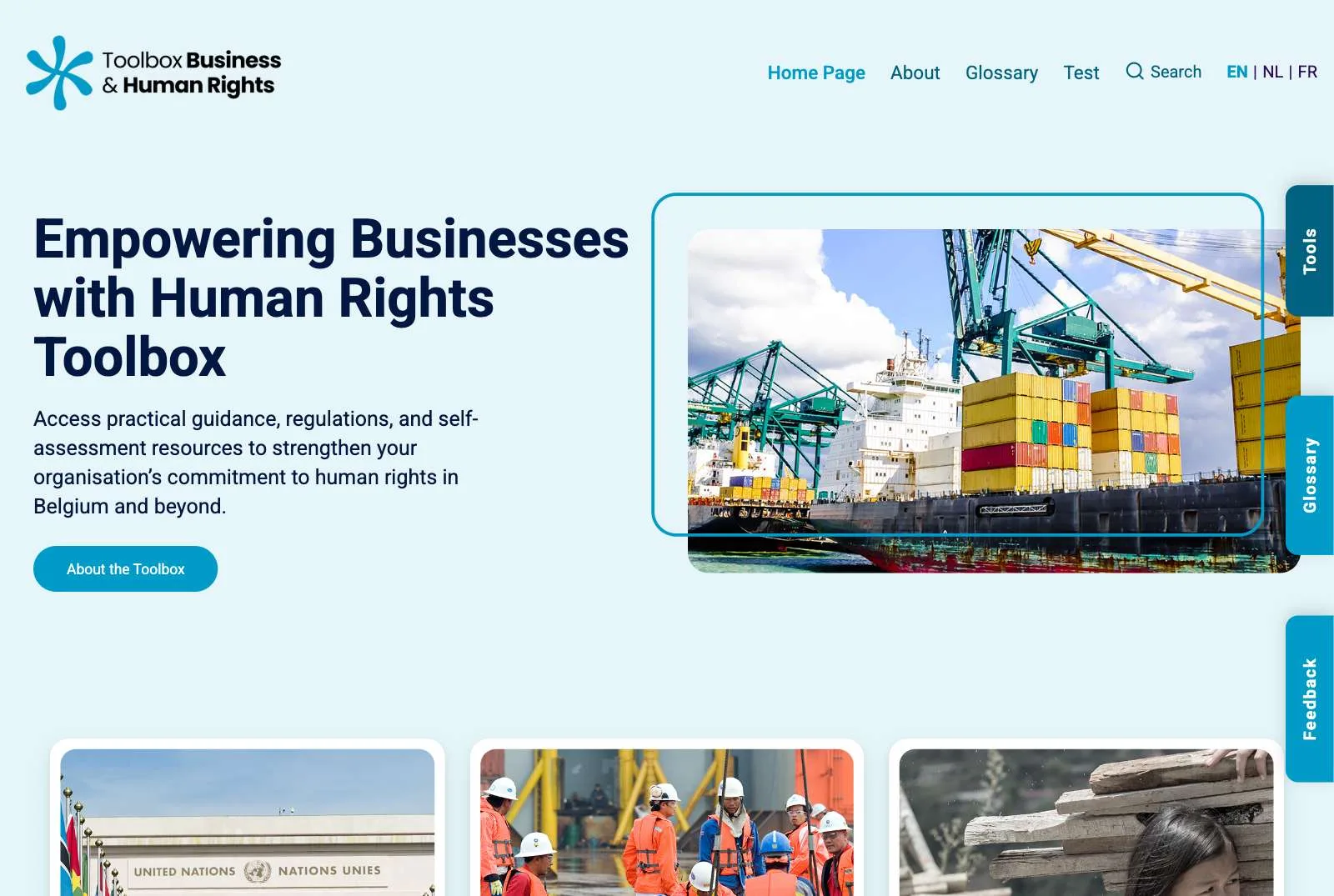
The result was a structured, multilingual HREDD digital toolbox that helps convert complex institutional knowledge into practical access pathways for businesses and other users, while also ensuring that the platform can be operated, updated, and expanded by the institution after handover.
- Partners
- Council of Europe, Belgian FPS Justice, KU Leuven (HIVA), VUB (Brussels School of Governance), NOVA School of Law
- Geographic scope
- Belgium / European Union
- Service type
- Digital Architecture, UX Restructuring, Multilingual Platform Development, Technical Implementation
- Role of Spontan
- Lead Digital Partner (Strategy, UX Structuring, Development)
- Languages
- English, Dutch, French (EN / NL / FR)
- Core deliverables
- Custom CMS, 25-question self-assessment tool, searchable legal/HREDD glossary, multilingual content infrastructure
- Handover package
- Full source code delivery, 100-page technical manual, customized online training sessions
- Delivery discipline
- Workflows aligned with ISO 9001 and ISO/IEC 27001 operational practices for controlled delivery and structured handover
Converting a Complex Policy Framework into a Practical Official Digital Resource for Businesses
The core challenge was not technical implementation alone. The real challenge was to transform a complex body of legal, policy, and academic content into a credible, usable, multilingual official platform that businesses could rely on when navigating Business and Human Rights and HREDD-related concepts.
As an official toolbox intended for broad institutional and business use, the platform needed to perform at a much higher standard than a typical informational website.
It had to simultaneously achieve:
- institutional credibility (accurate representation of policy and legal content)
- practical usability (clear pathways for businesses and non-specialist users)
- multilingual consistency (EN / NL / FR content structure and governance)
- technical maintainability (long-term updates and expansion after handover)
- operational continuity (documentation and team readiness for independent management)
This created a high-stakes delivery environment where simplification could not come at the cost of accuracy, and technical execution could not be separated from governance, content structure, and long-term institutional use.
In practical terms, the challenge was to build a platform that could serve as:
- a trusted reference point for businesses and stakeholders
- a usable toolbox rather than a static policy archive
- a multilingual institutional system that could remain functional and manageable after project completion
This required a combined approach across UX logic, information architecture, multilingual structuring, and disciplined technical delivery.
From Expert Content to a Usable, Maintainable, Institution-Managed HREDD Toolbox
Spontan solved a delivery problem that is common in policy-driven digital projects and often underestimated:
How do you convert expert legal and policy content into a practical digital toolbox that businesses can use, while preserving institutional accuracy and enabling long-term autonomy after handover?
Our role was not limited to development. We addressed the structural gap between expert knowledge production and real-world digital usability.
Spontan’s contribution was not limited to implementation. We solved a core delivery problem common in policy platforms:
How do you turn expert content into a functional, multilingual, institution-managed digital tool without losing accuracy or long-term maintainability?
To address this, Spontan focused on:
- translating policy-heavy content into clearer user pathways
- improving information architecture and content discoverability
- creating multilingual infrastructure that supports structured governance
- implementing functional tools (self-assessment and glossary) for applied use
- preparing the platform for institutional autonomy through documentation and training
This approach helped move the platform beyond static publishing into a more usable and scalable institutional resource.
- 01
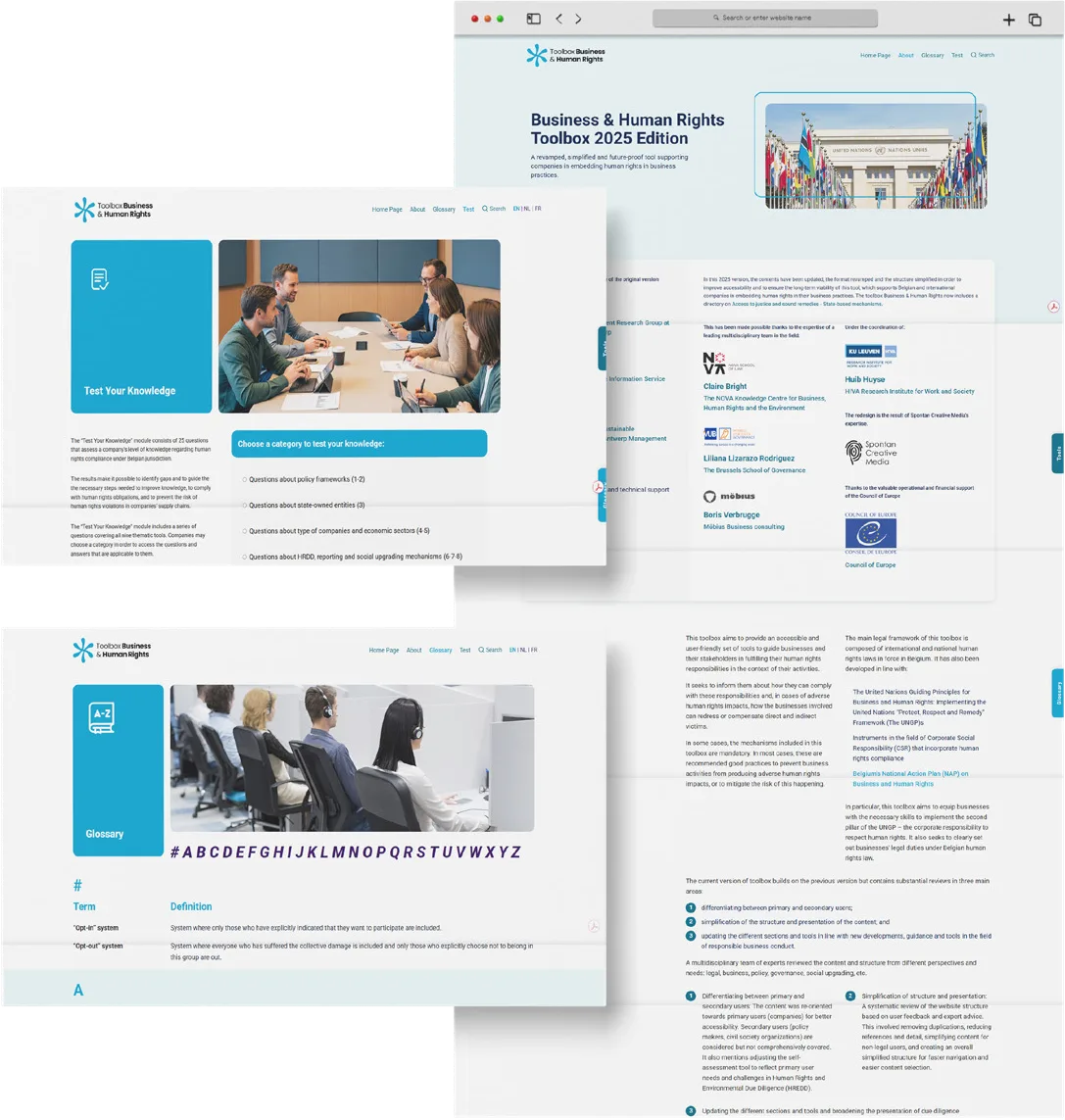
We translated complexity into usable access pathways
Policy and legal content is often accurate but difficult to navigate in practice. Spontan restructured the digital experience to improve clarity, navigation flow, and user access to key topics.
This helped shift the platform from a reading-heavy resource toward a more practical user environment where businesses and stakeholders could identify relevant content faster.
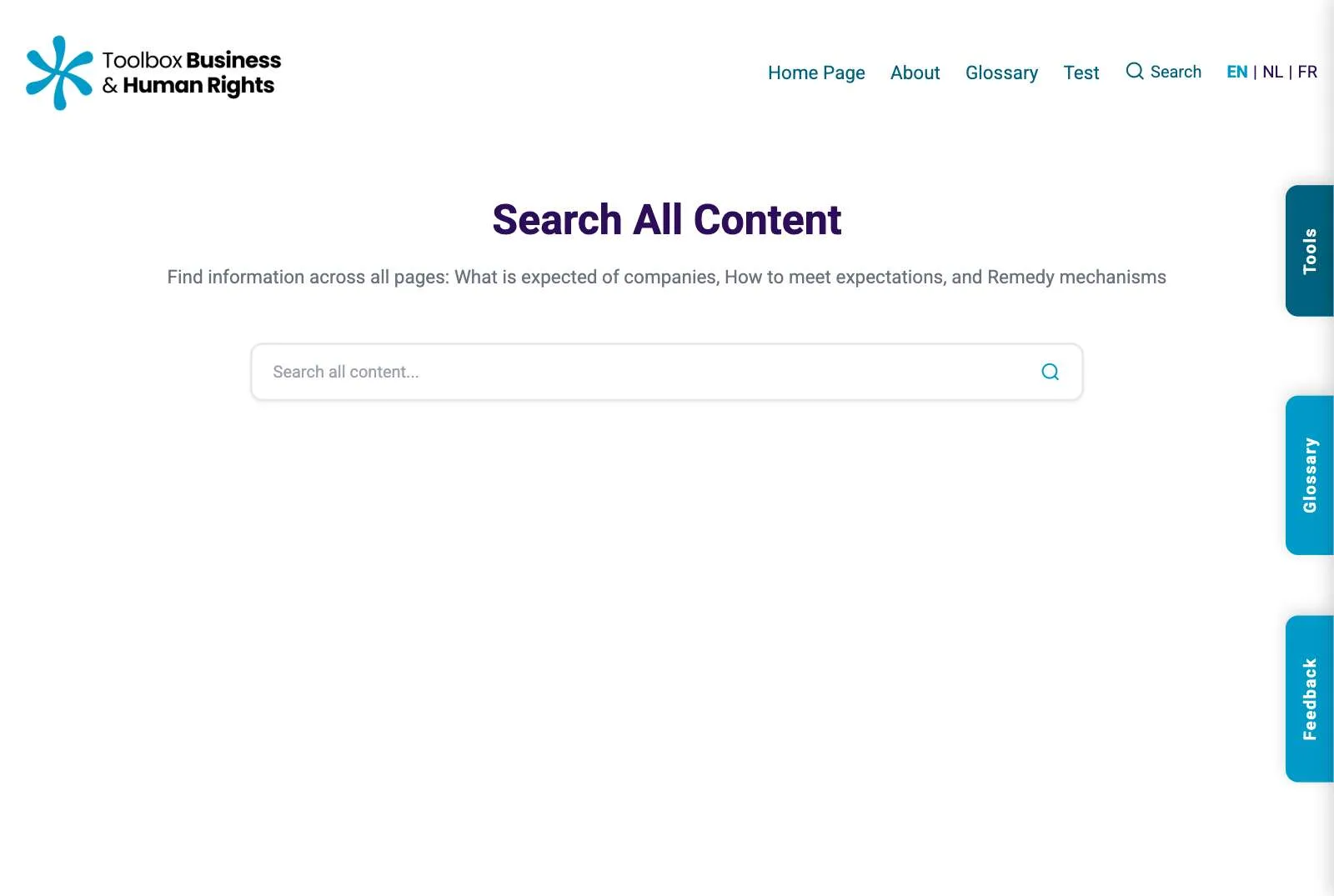
Search across all content - 02
We turned a content-heavy platform into a functional toolbox experience
Instead of treating the project as a standard content publishing website, Spontan implemented a toolbox-oriented structure supported by practical user components, including:
- a 25-question self-assessment module
- a searchable legal/HREDD glossary
- clearer content pathways and structured topic access
This increased the platform’s practical value for users who need guidance, definitions, and self-orientation, not only institutional text.
- 03
We built a multilingual infrastructure designed for institutional governance
Spontan implemented a structured EN / NL / FR platform environment with multilingual content logic designed for consistency and long-term maintainability.
This was critical for ensuring the platform could function as an official multilingual resource rather than a fragmented set of translated pages.
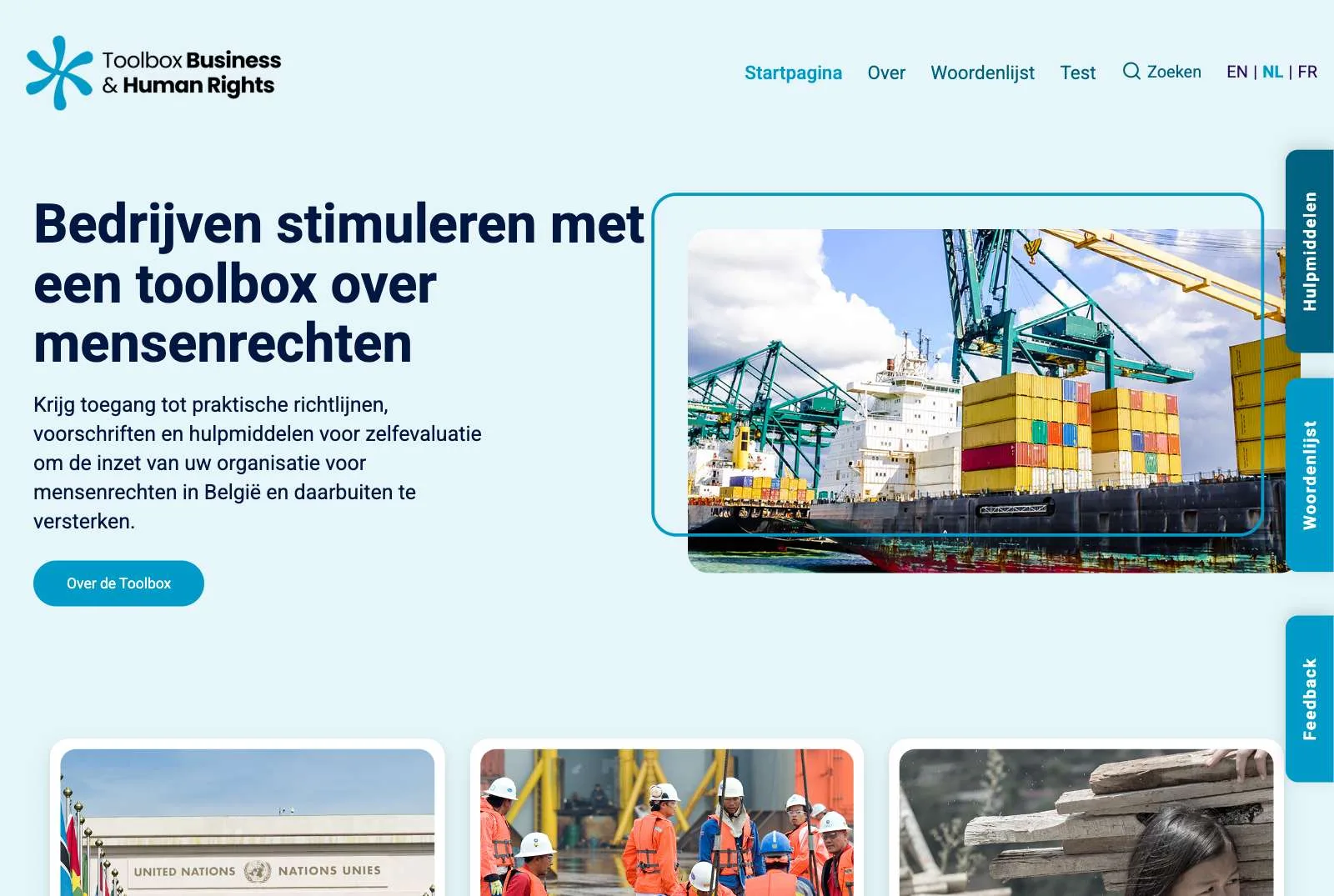
Dutch (NL) 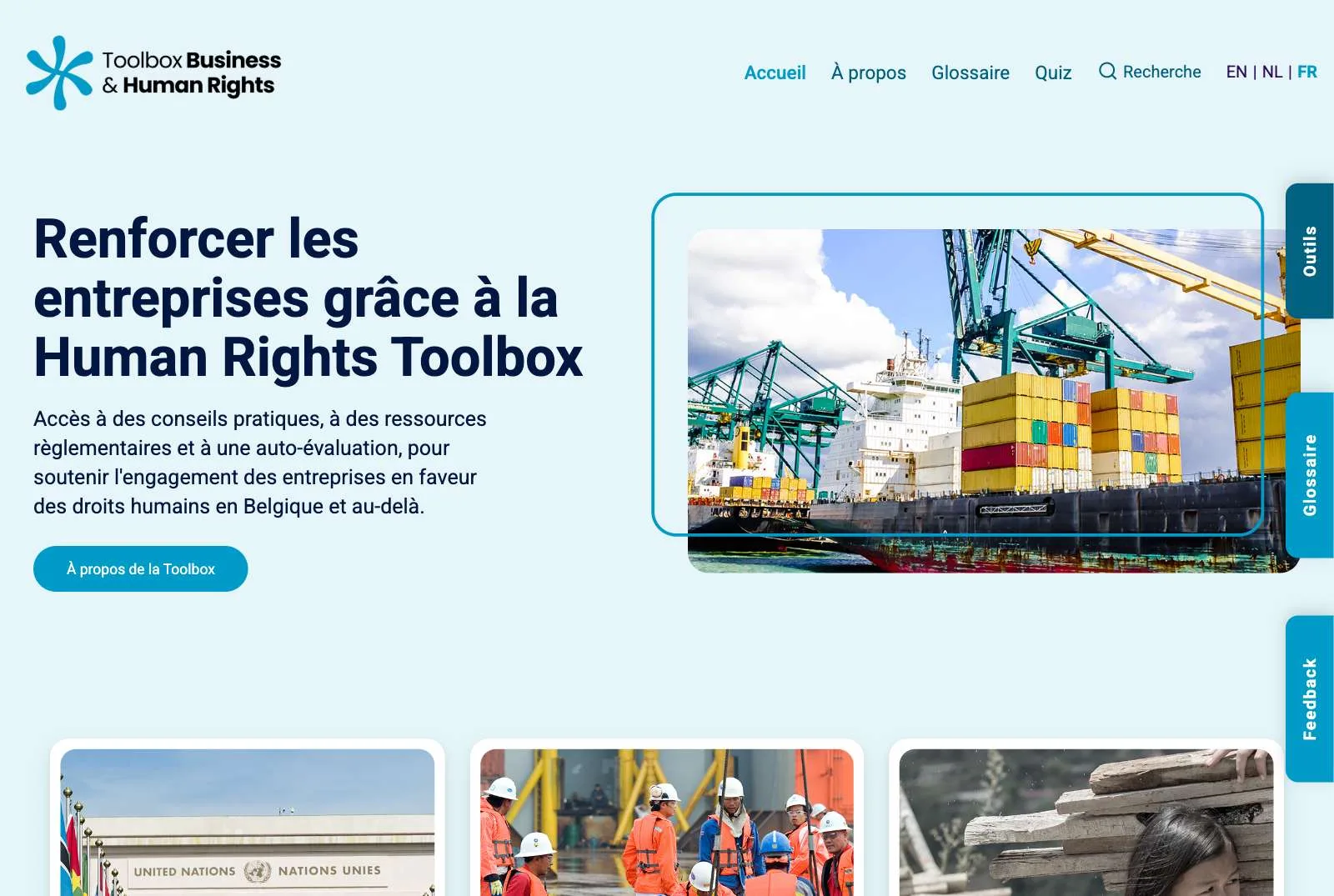
French (FR) - 04
We delivered with documentation discipline in a multi-stakeholder context
Because the platform involved institutional and academic stakeholders, delivery quality depended on more than coding. It required structured implementation, traceability, and handover readiness.
Spontan applied documented operational workflows aligned with ISO 9001 and ISO/IEC 27001 practices to support:
- consistency in technical delivery
- structured documentation and handover preparation
- process discipline in a policy-sensitive environment
- 05
We prepared the platform for long-term institutional autonomy
A major part of Spontan’s contribution was continuity planning after launch.
To reduce vendor dependency and support institutional ownership, we delivered:
- full source code handover
- a 100-page technical manual
- customized online training sessions for platform administration and content workflows
This ensured the platform was not only launch-ready, but also operationally transferable.
Spontan’s core value was the ability to connect five things that are rarely delivered well together in one project:
- policy accuracy
- user usability
- multilingual structure
- technical maintainability
- institutional autonomy after handover
That combination is what made the platform more than a website and positioned it as a durable institutional digital toolbox.
Platform video1
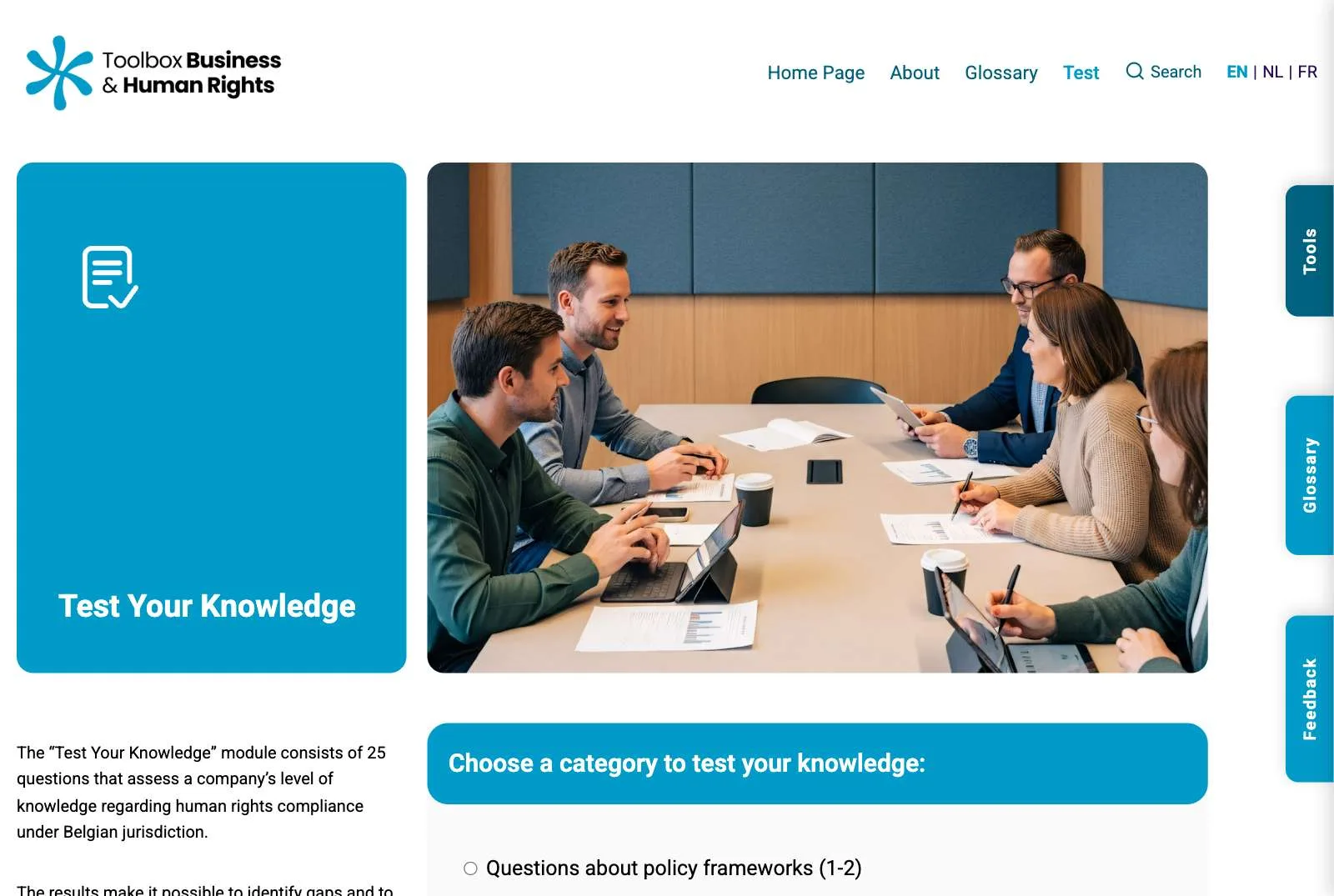
Interactive self-assessment module (25 questions)
Spontan developed a custom self-assessment tool with 25 targeted questions to help companies identify knowledge gaps and improve understanding of human rights compliance-related concepts.
This module supports:
- practical self-evaluation
- user engagement
- structured learning pathways within the platform
Searchable legal and HREDD glossary
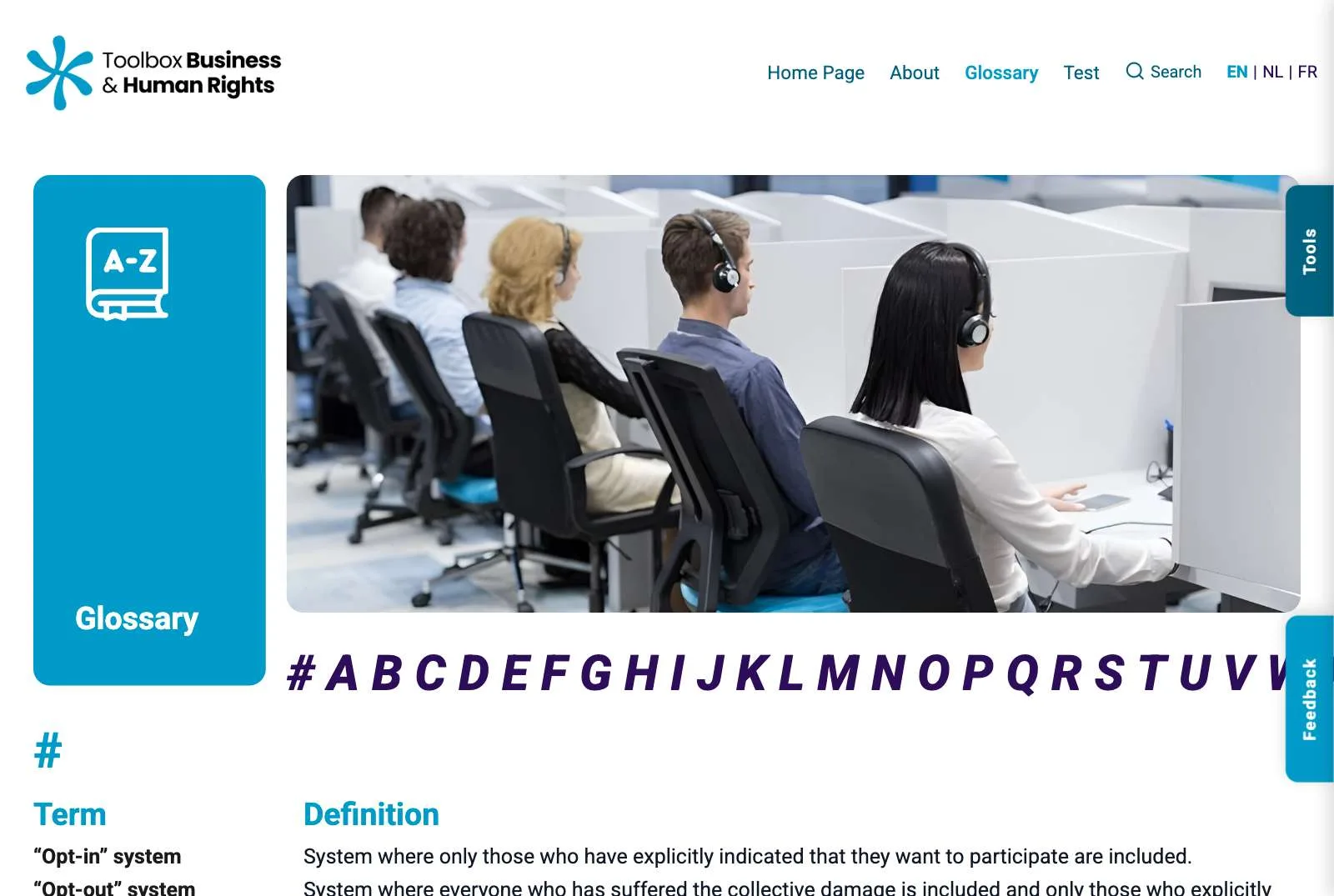
Spontan implemented a searchable, alphabetical glossary of legal and policy terminology to improve clarity and speed of access for diverse user groups.
This created a critical usability layer for a platform dealing with complex institutional concepts and helped users move faster from definition to application.
Multilingual institutional infrastructure (EN / NL / FR)
A seamless three-language infrastructure (English, Dutch, French) was implemented to meet accessibility and communication expectations in a multi-stakeholder European context.
The multilingual setup was designed to support:
- structured content governance
- consistency across language versions
- long-term maintainability by institutional teams
Custom CMS and structured content management
The platform was developed with a custom content management environment designed for institutional continuity and controlled updates.
The CMS and content structure support:
- multilingual content updates
- structured administration
- future section expansion
- ongoing maintenance and institutional ownership
A project like this delivers long-term value only if the institution can operate and evolve the platform after launch.
To support that, Spontan delivered a structured continuity package built around institutional autonomy.
Full source code delivery + documentation
Complete source code with a detailed documentation was delivered to ensure institutional ownership and future technical independence.
Customized online training sessions
Spontan delivered targeted online training sessions for the institutional team to support:
- platform administration
- content governance workflows
- multilingual update practices
- internal confidence after handover
This reduced dependency on external support and improved post-launch operational readiness.
100-page technical manual
A comprehensive 100-page technical manual documented platform logic, operational structure, and key maintenance and usage procedures to support internal continuity.
The launch of business-humanrights.be resulted in a structured, multilingual HREDD digital toolbox that translates institutional and academic input into a more practical user environment for business and stakeholder use.
- 01
Practical access to complex content
Legal and policy-heavy material was restructured into a more usable digital experience for companies and other stakeholders.
- 02
Institutional-grade multilingual governance
EN / NL / FR infrastructure enabled broader access while supporting long-term language-managed continuity.
- 03
Functional user tools
The 25-question self-assessment module and searchable glossary improved usability beyond static content publishing.
- 04
Long-term continuity readiness
Full source code delivery, technical documentation, and team training supported institutional autonomy and post-launch governance.
- 05
Controlled delivery and documentation quality
ISO 9001 and ISO/IEC 27001-aligned operational practices reinforced implementation consistency and handover readiness.
By combining digital execution with content structuring and continuity planning, Spontan helped transform a complex policy initiative into a maintainable institutional digital platform.
The following elements were implemented and delivered as part of the project scope:
- 3-language institutional platform infrastructure (EN / NL / FR)
- 1 custom interactive self-assessment tool with 25 questions
- 1 searchable legal/HREDD glossary (alphabetical, user-facing)
- 1 custom CMS / structured content management environment
- Full source code handover
- 100-page technical manual
- Customized online training sessions for institutional team onboarding and continuity
What is HREDD and why does platform usability matter?
HREDD (Human Rights and Environmental Due Diligence) frameworks can involve complex legal, policy, and operational concepts. Platform usability matters because users need to understand and apply these concepts in practice, not only read about them.
What makes this project more than a standard website development assignment?
The project required translation of institutional and academic content into a practical digital toolbox, multilingual infrastructure, custom user tools, structured content governance, and a full handover package for long-term institutional autonomy.
Why is source code handover and documentation important in institutional projects?
Institutional platforms need continuity beyond launch. Source code handover, technical documentation, and training reduce dependency on a single vendor and support long-term ownership, updates, and internal capacity-building.
Can Spontan deliver similar platforms for public institutions, NGOs, and donor-funded programs?
Yes. This case study demonstrates a delivery model suited to policy-informed, multilingual, and governance-sensitive projects that require both technical implementation and long-term operational readiness.
The business-humanrights.be project demonstrates Spontan Agency’s capacity to deliver policy-sensitive, multilingual, and maintainable digital platforms for institutional and multi-stakeholder environments.
Our role combined:
- digital architecture and UX structuring
- multilingual platform development (EN / NL / FR)
- custom toolbox functionality (including self-assessment and glossary tools)
- documentation-based handover and continuity planning
- team training for post-launch autonomy
- quality- and security-disciplined delivery practices
The result is a platform designed not only to launch successfully, but to remain usable, governable, and institution-ready over time.
This case reflects the type of execution required for public sector, donor-funded, and multi-stakeholder digital initiatives where clarity, continuity, and long-term operational value are as important as the build itself.